Monday, June 13, 2022

The Second Day (Revised/Revisited)


        For the Christian, Christ Jesus has experienced all, conquered all and promises to be with us all - no matter what each day holds. John records Jesus said,

“I have told you these things, so that in me you may have peace. In this world you will have trouble. But take heart! I have overcome the world.” (John 16:33).

        There is what Christians celebrate as Good Friday and Resurrection Sunday, however much of Christ’s victory for believers stems from holding fast to Christ's continued work or love on The Second Day.

        Just because the price was paid by Jesus on the cross did not mean Christ stopped working. Sometimes, our Second Day is mercifully short and other instances prove to be so long we wonder if this too shall pass. I believe a big key to keeping despair, fear and discouragement away is to remain busy with the Lord's work.

        Paul, in his letter to the believers in Ephesus, quotes Psalm 68:18 in describing where Jesus was and what He did on The Second Day.

"This is why it says: 'When he ascended on high, he took many captives and gave gifts to his people.'

(What does “he ascended” mean except that he also descended to the lower, earthly regions? He who descended is the very one who ascended higher than all the heavens, in order to fill the whole universe.)" - Ephesians 4:8-10


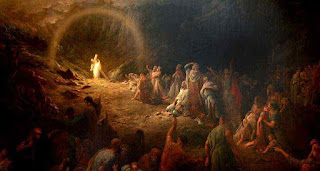
        This Ephesian passage is one source that Christians receive the location of Hades somewhere deep in the bowels of the earth. Researching the original Greek for "lower, earthly regions", katoteros is the word used for "lower" and means inferior (locally, of Hades). The "earthly regions" part tell us this is an actual place beneath our feet. What was Jesus doing there? He was taking captivity captive or setting the captives free.

        1 Peter 3:18-20 actually gives us a mental picture of how Christ did this.

"For Christ also suffered once for sins, the righteous for the unrighteous, to bring you to God. He was put to death in the body but made alive in the Spirit. After being made alive, he went and made proclamation to the imprisoned spirits— to those who were disobedient long ago when God waited patiently in the days of Noah while the ark was being built."

        Here we have a little more detail. Seemingly, those who died from the days of Noah until Christ's days are the ones mentioned here as being ministered unto. And Peter echoes this notion in 1 Peter 4:6 where he states –

“For this reason the gospel was preached even to those who are now dead, so that they might be judged according to human standards in regard to the body, but live according to God in regard to the spirit.” 

        What did He proclaim? The power of His saving blood for the redemption of all humanity - past, present and future! I can hear an imprisoned spirit saying at that moment, "How are we going to see this salvation manifested?" Then Jesus might have replied, "You will ascend with me to Paradise after I take back my life from death, Hades and the grave and show my enemies defeated."

        Paul and Timothy continue this in their letter to the believers in Colossae and include this image of the Triumphant Christ.

"When you were dead in your sins and in the uncircumcision of your flesh, God made you alive with Christ. He forgave us all our sins, having canceled the charge of our legal indebtedness, which stood against us and condemned us; he has taken it away, nailing it to the cross. And having disarmed the powers and authorities, he made a public spectacle of them, triumphing over them by the cross." - Colossians 2:13-15

"The word 'triumph' is taken from the Greek word triambeuo, which is a technical word used to describe a general or an emperor returning home from a grand victory in the enemy's territory. Specifically, the word "triumph" was used to describe the emperor's triumphal parade when he returned home.

When a returning emperor or general came striding through the gates on his big, powerful, and beautiful horse, he was accompanied by his fellow victorious warriors, who also appeared glorious after their triumphant battle. As the parade followed, the weaponry and treasures seized from the enemy's territory were grandly displayed for all to see.

The grand finale to this triumphal procession was the foreign ruler himself. This ruler had been beaten and bound in chains and was now being forced to walk in disgrace, shame, dishonor, embarrassment and humiliation as crowds of people came to celebrate his defeat and to get a 'peek' at a once-powerful but now totally defeated opponent.

So when Colossians 2:15 declares that Jesus triumphed over evil powers, it is explicitly declaring that Jesus took the enemy apart piece by piece as He thoroughly 'spoiled principalities and powers'." (p.75, Sparkling Gems from the Greek, Rick Renner)


        Because Christ not only overcame the world, but also overcame the prince of this world, Satan, his minions, death and the grave - the believer’s enemy is the walking dead and/or walking defeated. Because of Christ’s compassion even in Hades and His triumph over all, Christians can have a peaceful, victorious and hope-filled day, every day, especially when they feel they are experiencing their day in between. Thank the Lord for His continued love and outreach, even on The Second Day.

Wednesday, June 1, 2022

LESSONS FROM HIS LETTERS (Part 8 - Conclusions)


        As I mentioned in Part One of this series (Ephesus), I hope you have observed the format Christ used to dictate for John to write to the believers. As review, in each letter - 
  1. Christ introduces Himself by way of declaring one or more of His many titles to the individual, to the congregation and/or church era which each church knows personally in some way. 
  2. In many of the letters He mentions the church's successes. 
  3. Jesus addresses the faults with each church. 
  4. Christ provides the solution. 
  5. He grants rewards for following through on learning the lesson and applying the solution. 
  6. Then Jesus, toward the end of each letter, repeats a phrase that is noticeably not seen again in the book of Revelation - "Whoever has ears, let them hear what the Spirit says to the churches." 
        Many biblical eschatologists believe the absence of this exact phrase in the remainder of Revelation is due to the Rapture of the church symbolized in Revelation 4:1 with John's calling up to the door in heaven - "After this I looked, and there before me was a door standing open in heaven. And the voice I had first heard speaking to me like a trumpet said, 'Come up here, and I will show you what must take place after this.'" 

        Reading Christ's words to John about showing him "what must take place after this", with "this" being the conditions of the letters and in particular, the last letter Laodicea - the conclusion is that Jesus is indeed speaking down through the ages to different church eras who will embody these traits.

        Therefore, the challenge is for today's church to cast off all issues of every church era, but especially Laodicea and seek the Godly counsel in each letter, especially that of Philadelphia.

        Dispensationalists could debate when they believe the Golden Age of the church was, but unfortunately that era, the church of Philadelphia, is in the past. Philadelphia and its characteristics are a church to model after. However, for all the greatness Philadelphia was noted and rewarded for - they lacked strength and that threatened the loss of their crown for services rendered down the road. The remedy mirrors Thyatira's solution, "Hold on to what you have." 

        Among other observations I might magnify, there are two that I wish to call to your attention. Throughout the letters there were two common threads - 
  1. Falsehood was and is taught, tolerated or displayed by church members.
  2. God observes and calls for a balance of proper, deeds/works for His kingdom beginning in the statement "I know your deeds...". This appears in five out of the seven letters - Ephesus, Thyatira, Sardis, Philadelphia and Laodicea. 
        Just like the mention of the deeds in five out of seven of the churches, falsehood appears in the same amount as an issue. Ephesus had issues with the false "practices of Nicolaitans". Smyrna had problems with slander from false Jews associated with the "synagogue of Satan". Pergamum had difficulty with false teachings of Balaam and the Nicolaitans. Thyatira had issues with a particular false teacher named Jezebel who brought sexual immorality and food sacrificed to idols into the community. And Sardis had a problem with portraying a false front or reputation for being a church that was alive. 

        Authenticity, genuine representation of Christ and His Word and honest accountability to Christ and each other are gone from these churches. Sadly, these characteristics describe the majority of the issues that have plagued the history of the church. Fear not! Christ loves us so much that He supplies us counsel with the solution. Christians just have to set aside our prideful stubborn ways and follow through with the instructions of Jesus.

        This statement from Christ, in five of these letters - "I know your deeds..." - not only supports God's omnipresence and all-knowingness, but displays Father God's heart through caring enough to mention He knows them and then proceeds to instruct on how to improve upon them. The Lord not only gives the churches a spiritual report card, but attaches the solution and benefits/rewards to the report also. Said another way - Each letter about their deeds is not only a confirmation of what James 2:17 says about the faith/works relationship, but is also a map of how to properly conduct our works.  James 2:17 - "In the same way, faith by itself, if it is not accompanied by action, is dead."

        My research and observations of these letters have led me to conclude that many of the churches, if not all, had the right foundation - Christ Jesus - but battled greatly with infiltrations of falsehood that incredibly influenced their deeds. Possible impacts upon the churches that led to each of their conditions might be - 
  • the location the churches were planted, 
  • the polytheistic environment the churches had to contend with and 
  • different, challenging, philosophical viewpoints. 
        All of these contributed to ramming against Christ's statement of "I am the way and the truth and the life. No one comes to the Father except through me." (John 14:6) 

        When the normal operation procedure for the Christian church is to gravitate away from the teachings of its Master and Founder - Christ Jesus, then the church has become a worldly, appeasement popularity club displayed through its richest members and those who are best at double-speaking. 

        Another phrase that is repeated in these letters by Christ is "To the one who is victorious...". This phrase assumes the Christian has obeyed the counsel outlined in each letter for each church. The Lord has dictated a Love Letter to the whole church, it's just divided into seven eras for the church and any periods like this for the individual. The two-part question is will we hear and capitalize on "what the Spirit says to the churches"?

LESSONS FROM HIS LETTERS - Part 7 Laodicea


        Throughout the seven letters to the churches, the loving concern is meted out in the hope that the individual, the church or the church era will follow the counsel supplied for the issue at hand. This last letter to the church in Laodicea is no different. If anything, this letter should scream to Christians today to take action. 

        Unfortunately, this church and its issues are said to be what many end-time scholars believe all Christians are moving into or are currently experiencing. 

"To the angel of the church in Laodicea write:

These are the words of the Amen, the faithful and true witness, the ruler of God’s creation. I know your deeds, that you are neither cold nor hot. I wish you were either one or the other! So, because you are lukewarm—neither hot nor cold—I am about to spit you out of my mouth. You say, ‘I am rich; I have acquired wealth and do not need a thing.’ But you do not realize that you are wretched, pitiful, poor, blind and naked. I counsel you to buy from me gold refined in the fire, so you can become rich; and white clothes to wear, so you can cover your shameful nakedness; and salve to put on your eyes, so you can see.

Those whom I love I rebuke and discipline. So be earnest and repent. Here I am! I stand at the door and knock. If anyone hears my voice and opens the door, I will come in and eat with that person, and they with me.

To the one who is victorious, I will give the right to sit with me on my throne, just as I was victorious and sat down with my Father on his throne. Whoever has ears, let them hear what the Spirit says to the churches.” (Revelation 3:14-22)

        Believers are especially known to be on God's heart and mind, before His sight and always hearing their thoughts and words. However, did you know Christians also reside within the mouth of God? According to Christ in Matthew 5:13 they are to be flavorful or salty like that of food. Then in this letter, Jesus adds the food/deeds need to be the right temperature. Jesus declares, as He does in four other letters, "I know your deeds...". For this church, what follows is not good. The observations demand change or harsh consequences occur. Jesus says, "I know your deeds, that you are neither cold nor hot. I wish you were either one or the other!"

        This letter speaks to the individual, the congregation and church era whose temp is lukewarm. This entreatment is a dire warning - "I am about to spit you out of my mouth." followed by the solution and rewards for obeying His counsel. God has done His part with Jesus' death, burial, and resurrection to secure the salvation of these believers. However, Christ has gone above and beyond by NOT YET spitting these people out of His mouth - "I am about to..."!

        The independent, indecisive and defiant Laodicean spirit has led them to say, "'I am rich; I have acquired wealth and do not need a thing.'" The god of wealth or means has puffed-up this church's pride and ego to the point they reject God's provision. Dependency on self and own wealth brings about complacency, middle-of-the-road behavior, straddle-the-fence mentality and/or lukewarmness in deeds. 

        Actions flow from where one's heart is. Whatever you appreciate, you will find a way to then honor, exemplify and serve others in that capacity. If you appreciate Christ's salvation, you will find ways to spread the good news to others. This whole process was totally missed by this church or at least forgotten because the second part of verse 17 reveals an additional condition - "But you do not realize ...".

        In their self-provision they are unaware of their extreme condition. But you do not realize that you are wretched, pitiful, poor, blind and naked.

        The original term for "wretched" in the Greek referred to a person miserable in life due to the constant trouble they are in, many of the instances revolving around money.

        The second word, "pitiful", describes a person who shows no mercy or compassion because they were shown none. They wallow in their muck and do nothing to try to change their condition.

        The word used for "poor" means financially distraught. Bankrupt and begging is a good description of this condition. Not a good status for any church or individual to be.

        Saying the church was "blind" referred to their loss of sight on God's ways. In fact, tuphoo, the Greek word here means high minded or lifted up with pride. So, not only did this church lose sight of God, but they turned their eyes and efforts inward.

        "Naked" meant the church was not wearing the righteousness or right-standing of Christ upon themselves daily. They were not holding themselves accountable to The One True God. Old Testament priests wore garments that reflected an inward dedication. Christian's dedication should be reflected in their deeds, behavior and words - an entire lifestyle.

        What a wonderful Savior! He took the time to say, "I counsel you to...."If He had not rebuked or disciplined these believers, I would be worried because His character is long-suffering, compassionate and counseling - "Those whom I love I rebuke and discipline."

        Christ's special identity to this church is "These are the words of the Amen, the faithful and true witness, the ruler of God’s creation." Amen means let it be so. God's word is final. When Christ speaks, He is vocalizing Father God's thoughts; whatever "it" is will be accomplished.

        The phrase "faithful and true witness" reflects God's omnipresence. The Spirit of Christ is everywhere, making Him not only a witness to everything but faithful in never leaving or forsaking believers and true in that He will never misrepresent Christians as our Advocate.

        The phrase "the ruler of God's creation" not only implies dominion and authority but sovereign sustainer of that which He created, which is everything.

        The solution to these consequences of being lukewarm is "buy from me gold refined in the fire, so you can become rich; and white clothes to wear, so you can cover your shameful nakedness; and salve to put on your eyes, so you can see."

        View your faith as gold and God as refining the gold, your faith, in His Holy fire. Within this process of perfecting our faith believers will be able to purchase what we need from the Lord.

        There is no sin, no disobedience of God, tiny or grand, that goes unnoticed and is not covered by the righteousness of Christ. Everybody's right-standing with God can only be found through the wearing of Christ's righteousness that He provided through His death and resurrection.

        Jesus provides more of The Answer when He says, "So be earnest and repent." If the believer follows through with this counsel, Christ states, "Here I am! I stand at the door and knock. If anyone hears my voice and opens the door, I will come in and eat with him, and he with me." The immediate reward for this church is a supernatural dinner with the Lord. Restoration of intimate fellowship and relationship with Christ. The future reward for the "victorious", those who continue to live in and by the solution is the right to sit on Christ's throne.

        Many believe this Laodicean Spirit has come and been upon the world for some time now. Believers in Jesus Christ have the answer. Christians need to get red hot passionate about Christ and His ways. Earnest prayer for every country, worldwide as the message of hope is  shared by the power of the Holy Spirit locally is our mission. God is disgusted with defiance, arrogance and pretending to be a believer in Christ, BUT He hasn't "spewed" them out of His mouth YET! So, for those that need to apply this, please follow His solution and keep from being God vomit!